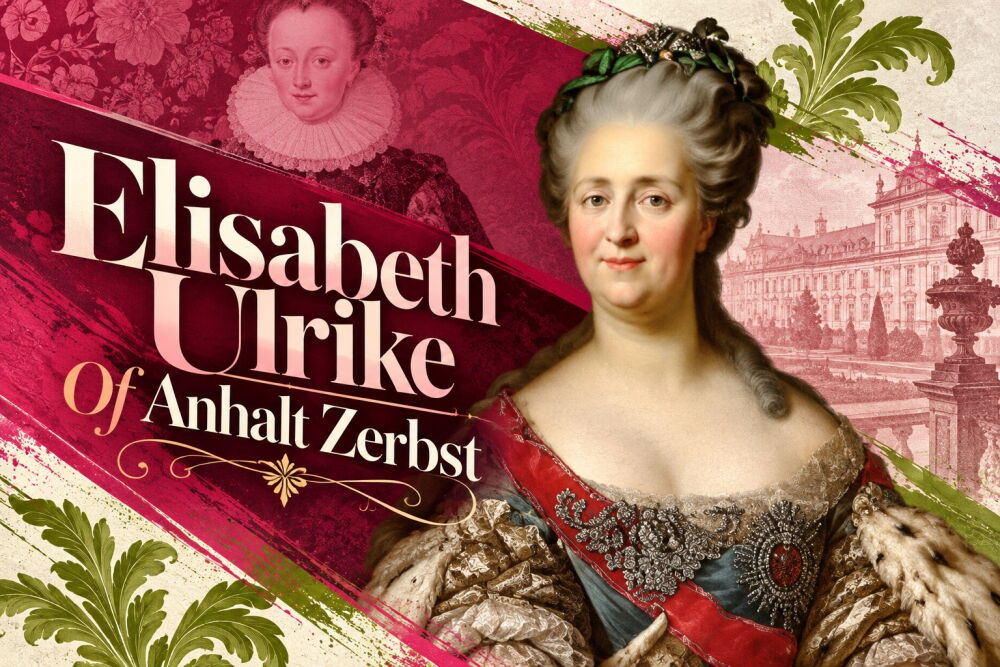
A short life in an expanding family story
I begin with the person behind the elaborate name. Elisabeth Ulrike Of Anhalt-zerbst was a child, born in Berlin on 17 December 1742 and dead in Zerbst on 5 March 1745. She lived for just over 2 years. She was the youngest sister of Sophie Auguste Friederike, the princess who later became Catherine II of Russia.
Her biography is brief because her life was brief. She did not marry, govern a territory, or enter a public career. The wider family history is rich, but I would not allow the later fame of her relatives to obscure the simple limits of her own story.
| Detail | Information |
|---|---|
| Name | Elisabeth Ulrike of Anhalt-Zerbst |
| Birth | 17 December 1742, Berlin |
| Death | 5 March 1745, Zerbst |
| Burial | St Trinitatis, Zerbst |
| Father | Christian August of Anhalt-Zerbst |
| Mother | Johanna Elisabeth of Holstein-Gottorp |
| Best known sibling | Sophie, later Catherine II |
Her father and a newly inherited principality
Christian August was born on 29 November 1690 at Dornburg. He belonged to a cadet branch of the Ascanian family and built a military career in Prussian service. He served as commandant and governor of Stettin and became a field marshal in May 1742.
The year of Elisabeth Ulrike’s birth also brought a dynastic change. Johann August of Anhalt-Zerbst died without children on 7 November 1742. Christian August and Johann Ludwig II inherited the principality together. Elisabeth Ulrike was born a few weeks later, in Berlin, at a moment when her father’s position had changed from a military prince of a junior branch to a reigning prince.
I find that timing more revealing than an ornamental title. Her birth belongs to the household’s transition between Stettin and Zerbst. It does not establish that she herself held political influence or a separate territorial inheritance.
Johanna Elisabeth and the Holstein connection
Her mother, Johanna Elisabeth, was born on 24 October 1712 at Gottorf. She married Christian August on 8 November 1727 at Vechelde. Her parents were Christian August of Holstein-Gottorp, Prince-Bishop of Lübeck, and Albertina Friederike of Baden-Durlach.
The repeated name Christian August can make a family tree deceptively confusing. Elisabeth Ulrike’s father was the prince of Anhalt-Zerbst. Her maternal grandfather was the Holstein-Gottorp bishop. They were different men occupying different branches of the family.
Through Johanna Elisabeth came links to Sweden and Russia. Her brother Adolf Frederick became crown prince of Sweden in 1743 and king in 1751. His sons Gustav III and Charles XIII were Elisabeth Ulrike’s first cousins, but both were born after her death. They could not have been childhood companions.
Five children and only two adult lives
Elisabeth Ulrike was the fifth and youngest child. The order of the siblings matters because several deaths occurred before she was born.
| Child | Dates | Place in the family |
|---|---|---|
| Sophie Auguste Friederike | 1729 to 1796 | Eldest, later Catherine II |
| Wilhelm Christian Friedrich | 1730 to 1742 | Elder brother |
| Friedrich August | 1734 to 1793 | Elder brother and later prince |
| Auguste Christine Charlotte | 10 to 24 November 1736 | Elder sister |
| Elisabeth Ulrike | 1742 to 1745 | Youngest child |
Wilhelm died on 27 August 1742, several months before Elisabeth Ulrike’s birth. Auguste had lived only 14 days in November 1736. I therefore would not describe all five as children growing up together. Only Sophie and Friedrich August survived into adulthood.
Friedrich August inherited Anhalt-Zerbst after their father’s death in 1747, with Johanna Elisabeth acting as regent until 1752. He married twice but had no children. His death in 1793 eventually led to the division of Zerbst among other Anhalt branches.
Sophie leaves for Russia
In January 1744, Johanna Elisabeth took Sophie to Russia. Elisabeth Ulrike remained behind. Sophie was being considered as the bride of Karl Peter Ulrich, the future Peter III, within the succession plans of Empress Elizabeth.
Sophie arrived in Moscow in February 1744 and entered a world that would transform her identity and position. She became Ekaterina Alekseevna and married Peter on 1 September 1745. Elisabeth Ulrike had died approximately six months earlier.
I keep those dates aligned because an account placing the child’s death immediately after Sophie’s arrival in 1744 creates an obvious conflict. The established death date is 5 March 1745. A loosely told sequence should not move it back a year.
Sophie became empress in 1762, more than 17 years after her youngest sister died. Elisabeth Ulrike never knew her as Catherine the Great. Her connection to that future reign is genealogical rather than a remembered relationship between two adult sisters.
A name and an unresolved detail
The child’s first name has been connected with Empress Elizabeth of Russia, who was said to have agreed to serve as godmother. That tradition fits the family’s Russian ambitions, although the godparent arrangement is less firmly documented than the birth and death dates.
The origin of Ulrike remains unclear. I would not automatically attribute it to Louisa Ulrika of Prussia, who married Adolf Frederick only in 1744. A later marriage does not explain a name already given in 1742 without additional evidence.
No established cause of death or securely identified portrait is included in this biography. Those gaps leave her life delicate and incomplete, but they do not justify inventing a medical explanation or a sentimental final scene.
FAQ
Was Elisabeth Ulrike Catherine the Great’s daughter?
No. She was Catherine’s youngest sister, born 13 years after Sophie, the future empress.
Was she the Electress of Brandenburg?
No. Elisabeth of Anhalt, the sixteenth century Electress of Brandenburg, was a different woman who lived from 1563 to 1607 and did not bear the name Ulrike.
How old was Elisabeth Ulrike when she died?
She was 2 years old. She was born on 17 December 1742 and died on 5 March 1745.
Did she have children or a political role?
She had neither. Her short life ended before marriage or any public role, while her surviving siblings later entered very different dynastic careers.